
A Corneal RGP for keratoconus
A central optic zone blends into a series of peripheral curves. Follow the profile as it reaches the edge.
Rigid gas-permeable corneal lenses restoring crisp, stable vision on keratoconic, irregular and regular corneas, with sharp optics and all-day comfort.
Keratoconus Corneal RGP
A central optic zone blends into a series of peripheral curves. Follow the profile as it reaches the edge.
A central optic zone blends into a series of peripheral curves. Follow the profile as it reaches the edge.
As the base-curve radius gets smaller, the central back surface gets steeper.
As the lens diameter increases, the optic zone and peripheral zones expand together toward the edge.
The aspheric optic zone can vary in size as part of the lens design for the shape of the cone.
The front optical profile changes from minus to plus power while the back curve holds its shape.
Five peripheral curves surround the optic zone. During fitting, fluorescein helps assess alignment over the cone.
The peripheral curves blend toward the rim. Edge lift can be adjusted to refine the fit.
The periphery can be toric to account for differences in corneal shape between meridians.
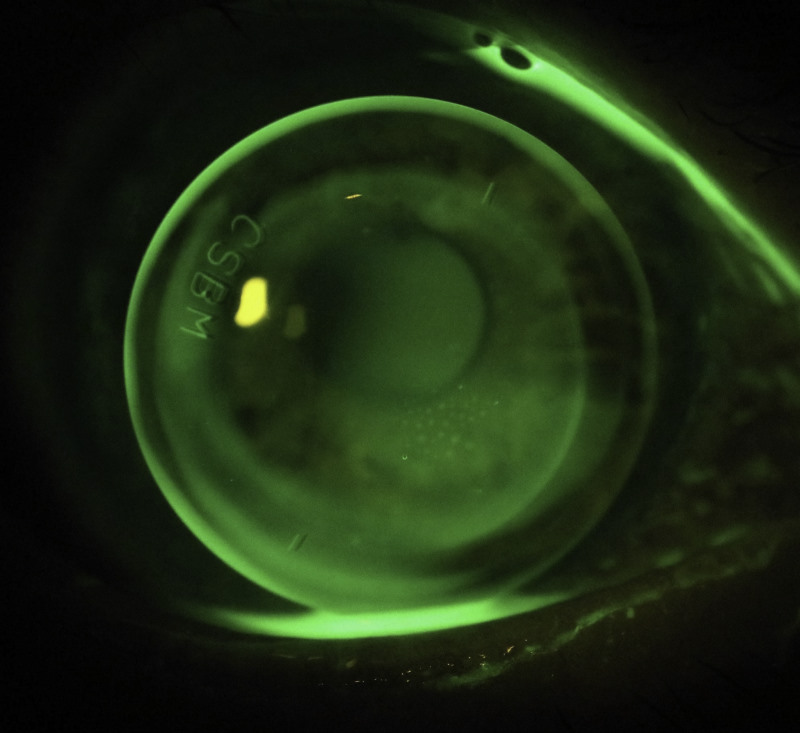

Keratoconus corneal RGP
Thinner, lighter, clear vision over the keratoconic cornea.
ORA K is VISIORA's corneal rigid gas-permeable lens for the irregular cornea. A keratoconus RGP engineered to deliver crisp, stable vision where corneal irregularity defeats spectacles and standard lenses. Its thin, lightweight design supports comfortable all-day wear while neutralising the optical distortion of the ectatic cornea. ORA K is fitted by fluorescein evaluation to achieve central alignment with a defined, well-controlled peripheral edge lift, with adjustable edge-lift and peripheral-toricity options for the most complex corneas.
Indications
Key Features
Parameters
Aspheric Corneal RGP
The lens profile changes smoothly from the centre to the periphery. Scroll to follow that transition.
The lens profile changes smoothly from the centre to the periphery. Scroll to follow that transition.
As the base-curve radius gets smaller, the central back surface gets steeper.
As the lens diameter increases, the optic zone and peripheral zones expand together toward the edge.
The optic zone blends smoothly into the aspheric curves toward the edge.
The front optical profile changes from minus to plus power while the back curve holds its shape.
Changing eccentricity changes how gradually the lens profile flattens away from its centre.
The peripheral profile continues into the edge. Fluorescein helps assess the fit on the cornea.
Aspheric RGP
One aspheric geometry, regular to ectatic corneas.
Ora Aspheric is a rigid gas-permeable corneal lens built on a multiaspheric geometry for regular corneal fitting, correcting corneal astigmatism of up to 3.00 D on a spherical-power platform. Because its asphericity is fully personalisable, the same lens extends naturally to corneas with high eccentricities and early ectatic conditions. Base curve is selected against the K plane using the corneal-astigmatism modification table, then refined chair-side by fluorescein evaluation and over-refraction.
Variants
Indications
Key Features
Parameters
Our technical team supports lens selection, custom parameters and fitting for every case.
Contact Us